

Planning a group celebration for 10 to 30 people in India
Headcount, menu format, dietary planning and the details that decide the evening
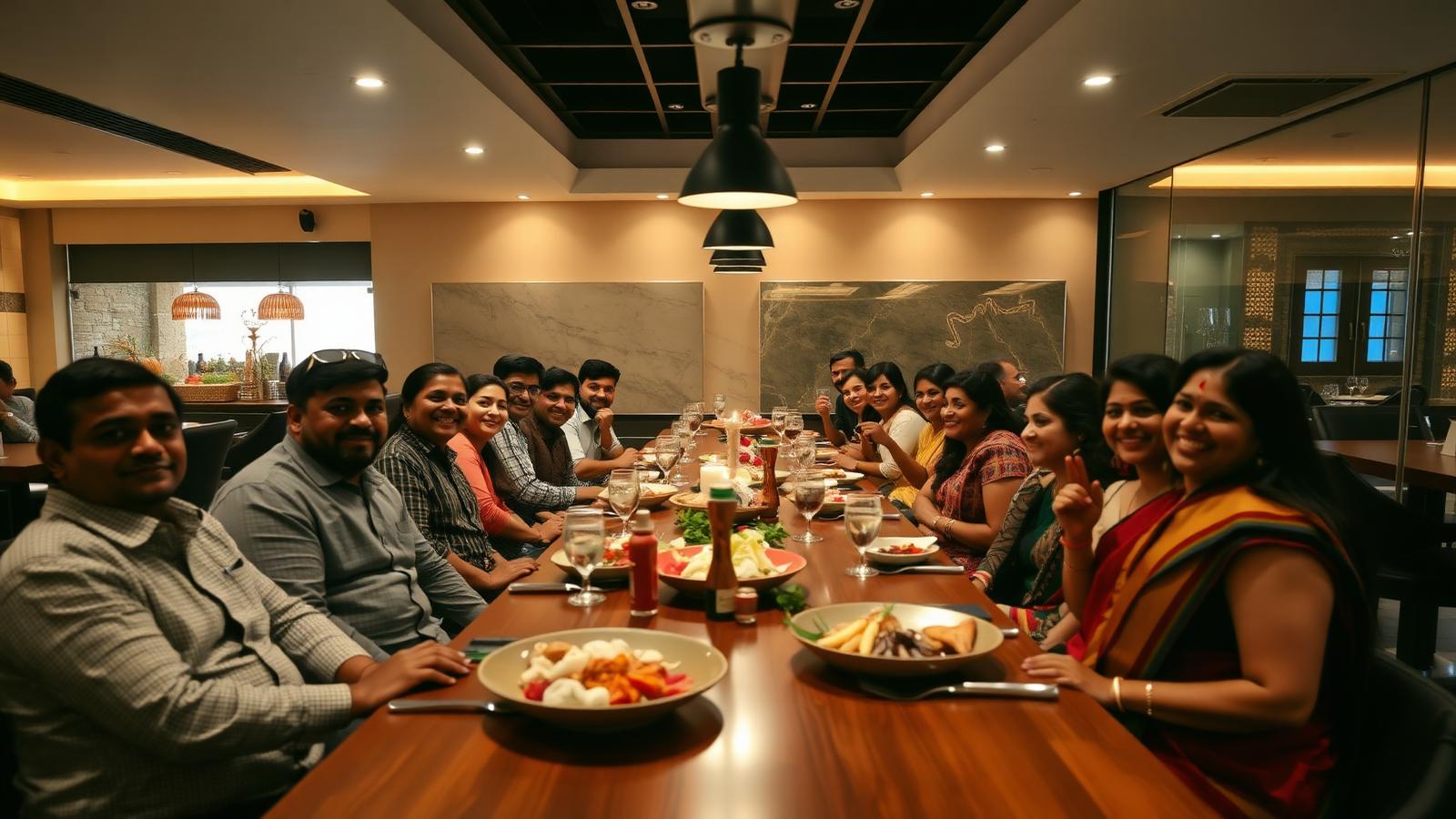
Ten to thirty people is the hardest group size in Indian dining. It is too large for a walk-in table and too small for a banquet hall, and it is exactly the size of most birthdays, anniversaries, housewarmings and family get-togethers.
Fix the headcount before anything else
Indian group celebrations almost always grow. A dinner planned for fourteen becomes twenty-two when three families decide to bring the children and someone''s cousin is in town.
Plan for that:
- Ask for confirmations, then add a realistic buffer of two to four.
- Tell the restaurant your expected range at the time of booking, not on the day.
- Confirm final numbers 24 to 48 hours before, which is what most kitchens actually need.
Choose the venue for the shape of the group
- 10 to 15 - a long table in the main dining room usually works, ideally in a corner away from speakers.
- 15 to 25 - ask for a semi-private section or a partitioned area. Most mid-sized restaurants have one.
- 25 to 30 - a private dining room or a terrace, generally with a minimum spend or a per-plate package.
Two practical checks people forget: parking for the number of cars you will actually bring, and lift access if elders are attending.
Buffet, set menu or a la carte
For this size, a la carte is a trap. Twenty people ordering individually means a ninety-minute wait and food arriving in three waves.
- Set menu (per plate) - predictable cost, faster service, easiest to manage dietary variants. Best for 10 to 20.
- Buffet - works well above 20, lets people serve themselves at their own pace, and handles mixed appetites. Check how many live counters are included.
- Family-style thali or shared platters - good middle ground, and closest to how most Indian families eat anyway.
Always ask what the package price includes: welcome drink, starters count, desserts, taxes, service charge and whether the cake cutting attracts a fee.
Dietary planning is the real work
An Indian group of twenty routinely includes several distinct requirements at the same table:
- Pure vegetarian guests who prefer a separate serving line, not just separate dishes.
- Jain guests - no onion, no garlic, no root vegetables. This needs kitchen notice, not a table request.
- Vegan guests, which in Indian menus mostly means avoiding ghee, paneer, curd and cream.
- Guests avoiding sugar or fried food, common in a multi-generational group.
- Non-vegetarian guests who will want at least a couple of substantial options.
Collect these in the group chat with one direct message, then send the restaurant a written list. A kitchen with a day''s notice can prepare Jain dishes properly; a kitchen asked at 8:30pm will improvise, and it will show.
Also confirm whether the venue serves alcohol, and whether that matters to any part of the family. It is better to know than to discover.
Timing for a mixed-age group
- Family celebrations with children and elders work best at lunch or an early dinner, around 7pm to 7:30pm.
- Friends-only celebrations can run later.
- Weekend evenings are the hardest slots to hold; a Friday lunch or a Sunday lunch is often cheaper and calmer.
Build in an arrival buffer. In most Indian cities, a group of twenty will not assemble within thirty minutes of the stated time. Tell the restaurant your service start rather than your invitation time.
Deposits, cancellation and payment
For groups above roughly fifteen, expect an advance or a per-plate commitment. Get the terms in writing: amount, what it is adjusted against, the cancellation window and the deadline for reducing the headcount.
Decide payment before the meal, not after the bill lands:
- One person pays and collects afterwards via UPI - simplest and most common.
- The hosts cover it entirely, which is the norm for milestone family events.
- A pre-agreed per-head amount, useful for friends'' groups.
Whichever you choose, announce it early so nobody arrives unsure.
Celebration details worth arranging
- Cake - confirm outside-cake policy, cutting fee, refrigeration and the time it should be brought out.
- Decor - a simple table setup, balloons or a backdrop. Ask what is permitted before you buy anything.
- Seating - place elders away from the music and children where the service path is clear.
- A short toast or a two-minute speech - one person, planned, not four unplanned ones.
Capture the memory, once, properly
Twenty people at a table produce two hundred blurry photos and no single good group picture. Fix it with one rule: take the group photo when everyone has arrived and before the food does. Assign one person. If the venue has a selfie wall or a memory mirror, use it - it is the easiest way to leave with a photo everyone is actually in.
A simple checklist
- Confirmed headcount and buffer
- Venue with the right seating shape and parking
- Menu format chosen and priced with taxes
- Written dietary list sent to the kitchen
- Deposit terms and cancellation window in writing
- Cake policy and cutting time confirmed
- Decor approved
- Payment method announced
- One person responsible for the group photo
How amealio helps
amealio is built around occasions rather than plain reservations, so group size, dietary requirements, menu format, celebration add-ons and memory capture sit in one flow instead of five phone calls. Preferences you record once do not need to be repeated at the next celebration. See celebrations and how it works.
Read next
Join the conversation
- Be the first to comment.